CITY MEMORY / NORTHERN SONG
東京夢華錄
A city remembered after it was lost.
Meng Yuanlao reconstructed Northern Song Kaifeng from memory after the dynasty fell and he moved south. Galok reads the book as an urban archive: walls, waterways, state logistics, streets, markets, wine houses, food, festivals and ordinary routines.
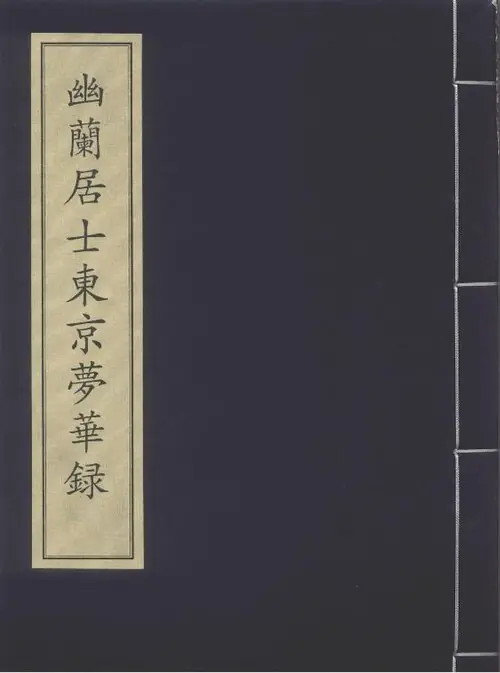
“Dongjing” (東京) here means the Northern Song Eastern Capital, Bianjing — present-day Kaifeng. It does not refer to Tokyo, Japan. The book was completed in 1147 after Meng Yuanlao had left the fallen capital and was recalling it from the south.
01 / VOLUME ARCHIVE
Ten volumes. Eighty-six entries live.
All ten volumes are now live: the city’s walls and waterways, its streets, markets and food, its labor, court ritual and social life, and the full festival year from the New Year lanterns through Qingming, the autumn festivals and the winter solstice to New Year’s Eve.IURBAN FRAMECOMPLETE / CITY STRUCTURE + STATE LOGISTICS01–066 / 6
The city's frame is complete.
Walls, the inherited old city, waterways, the imperial precinct and supply bureaucracy establish the physical and logistical ground of Northern Song Kaifeng.
IISTREETS & FOODCOMPLETE / STREET + MARKET + WINE + FOOD07–148 / 8
The city opens onto the street.
Volume II moves from controlled imperial space into neighborhoods, night markets, wine houses and food. Entries 12–14 complete the sequence by narrowing from district network to building to table.
IIIHOW THE CITY WORKSCOMPLETE / SPECIALISTS + LOGISTICS + MONEY + LABOR + SAFETY + DAILY SUPPLY15–2713 / 13
The operating city is complete.
Volume III moves from specialist streets and institutional corridors through temple commerce, freight, money counting, labor and fire response, then closes with predawn supply and the household-scale service city.
IVCOURT LIFE, RENTALS, RESTAURANTSCOMPLETE / COURT · RENTALS · FOOD TRADES28–3912 / 12
The court moves through the city, then sits down to eat.
Volume IV ran from the court into the rental city and closed in the food city: the uniformed services, the crown prince's marriage, a princess's procession, the empress's palanquin, funeral tariffs, the morning hiring pool, the banquet bureaus — then the silver tableware standard, the restaurant order relay, the knife stalls, the bread ovens and the fish gates. The volume is complete.
VCUSTOMS, ENTERTAINMENT, MARRIAGE, CHILDRENCOMPLETE / ALL FOUR ENTRIES LIVE40–434 / 4
How the city ran its social life.
Volume V is the book’s sociology in four movements: the street customs that made everyone readable, the playbill of the entertainment district, the negotiated chain of a wedding, and a first year counted in rites. Every entry is live.
VINEW YEAR TO LANTERNSCOMPLETE / FESTIVAL CALENDAR LIVE44–518 / 8
The year’s great observances.
Volume VI follows the festival calendar from New Year to the lantern festival’s close: the diplomatic protocol of the New Year assembly, the spring ox rite, the lantern mountain’s mechanical spectacle, the imperial processions and their enforced boundaries, the signal that darkened the city, and the suburban exodus into spring.
VIIQINGMING, GARDENS, IMPERIAL SPECTACLECOMPLETE / ALL NINE ENTRIES LIVE52–609 / 9
Spring opens the gates.
Volume VII follows the crowds out of the city for Qingming, then into the Golden Bright Pond and Qionglin Garden, where the court opens its water, its towers and its banquets to the public. Every entry is live.
VIIISPRING TO DOUBLE NINTHCOMPLETE / ALL TEN ENTRIES LIVE61–7010 / 10
A year of small festivals.
Volume VIII runs through the Buddha’s birthday, Duanwu, the deities’ birthdays, the Seventh Night, the Ghost Festival and the autumn festivals to Double Ninth, with the street vendors who supplied each one. Every entry is live.
IXTENTH MONTH, BIRTHDAY RITES, WINTERCOMPLETE / ALL FOUR ENTRIES LIVE71–744 / 4
The court banquet, in order.
Volume IX moves from the first day of the tenth month to the emperor’s birthday banquet, set out in the order of its cups, music and acts, and closes at the beginning of winter. Every entry is live.
XWINTER SOLSTICE TO NEW YEAR’S EVECOMPLETE / ALL TWELVE ENTRIES LIVE75–8612 / 12
The Grand Sacrifice, then the year’s end.
Volume X follows the emperor through the winter-solstice Grand Sacrifice, from rehearsal and procession to the altar, the amnesty and the thanksgiving visits, then the twelfth month and New Year’s Eve, and ends with Meng’s own closing note. Every entry is live.
夢AFTERWORDTHE BOOK AS A MEMOIR OF A LOST CITY夢END
Read last.
The reading room has followed a city at work. The afterword shows what it was written for: a city drawn, lit with 135 places from the book, and put out, with Meng Yuanlao’s own preface read at the end.
02 / VISUAL WITNESS
Read the text beside a handscroll.
《清明上河圖》 and 《東京夢華錄》 preserve different kinds of evidence about Northern Song Kaifeng. The painting is a visual witness, not an illustrated edition of Meng's book.SCROLL / ZHANG ZEDUAN

03 / SOURCE ROOM
Keep the city attached to evidence.
Historical scans are public-domain witnesses. Electronic transcriptions and modern research are used comparatively, with variant readings kept visible where the evidence diverges.Historical printed Meng Hua Lu
National Library of China digitization used throughout the first volumes.
EARLY WITNESS / PUBLIC DOMAINYuan blockprint
A key early witness for text-lock work in Volume III.
COLLATION / YUAN BLOCKPRINTLu Xinyuan's collation
Explicitly records omissions and corruptions including 西榆林巷, 衣物圖畫, 霜蜂兒 and the title 馬行街北諸醫鋪.
TRANSCRIPTION / COMPARISONSiku Volume III
The working transmitted text for Entries 15–27 is crosschecked against other witnesses rather than treated as a single definitive edition.